Showing posts with label classic film. Show all posts

Sunday, June 2, 2013

Screenwriting Influences


One of my favorite movies is An American Werewolf in LondonWhile it may not be the greatest film ever, no film has had more influence on my writing than this. It's a very uneven, odd film. It opens to a slightly corny gothic horror sequence, then spends the next 45 minutes on the main character recovering from a werewolf attack in a hospital. From here it's almost a romance film, until the next full moon, when all hell breaks loose. My only issue with it is that there isn't really an ending at all, but you could argue it just adds to the style.

Almost everything I've written since has been influenced by the style of John Landis's script. The odd, anything-goes vibe is always what I'm shooting for, whether romantic comedy or slasher.
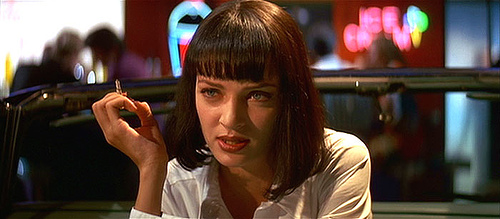

More films that influenced me are Breathless (1960), The Texas Chain Saw Massacre (1974), and Pulp Fiction. Though when it comes to Pulp Fiction, it's not in the way you would expect.

I don't write pages and pages of worthless dialogue like most Tarantino copycats. The film influenced my writing in other ways: focusing on creating memorable characters over plot. It's more of a novel than a conventional movie. Just characters going through their days.

Breathless is important to me because it's relatable.

Jean-Luc Godard got together a couple actors and a camera and went out and shot his movie. It's something I could do. Whether or not I end up making one of the best films ever is something we'll have to wait and see, but it's nice to know that it's something basically in reach. You don't need a budget to make a great film people still watch fifty years later.

I also admire the story of Breathless, if there even is one. It's 90 minutes following an interesting car thief around town, getting into deeper trouble. It's an anything-goes, poetic story, exactly what I'd love to make someday.

And lastly, The Texas Chain Saw Massacre.

Every film I've mentioned so far is in my top ten, including this one. Yes. My top ten. Many people discount it as a cheap gore flick, but they're the ones that haven't seen it. It's a very effective film, and has stood the test of time better than almost any other horror film. It's been copied countless times. And like Breathless, it is a film made without many things at their disposal. It's just some filmmakers with a cool idea, a few thousand dollars, and a farmhouse.

When I write horror, I try to channel the feeling of dread this film uses so well. If you want to learn how to write horror, this film is perfect. It masterfully executes dread, suspense, shock, disgust, and pure tension. With what? A van, a farmhouse, less than a dozen actors and barely any blood... oh yeah, and a chainsaw. Copycats over the years have slightly stained this film's reputation, but anyone who's actually seen it knows how effective it can be.

That's my list. Other notable films are Goodfellas, Blade Runner, 2001: A Space Odyssey, Signs, Faster, Pussycat! Kill! Kill!, Battle Royale and Back to the Future.

If you're a writer, which films or books-- maybe even music-- have influenced your work the most?

Friday, March 8, 2013

Dawn of the Dead (1978) Review


A follow-up to my Night of the Living Dead review. When I get around to seeing Day of the Dead, I'll probably review that too.


George A. Romero's second zombie film picks up right where its predecessor, Night of the Living Dead, made ten years earlier, left off. Why he waited this long to make another one, I'm not quite sure. As far as I know, Night was pretty dang successful, spawning an entire horror subgenre and creating a whole new list of horror cliches (which Dawn added to immensely).

I think one reason Romero waited a decade for the sequel is that the Living Dead films are social commentaries as much as they they are zombie films (which is why so many other zombie films fail. Most big-budget zombie films can't hold a candle to Romero's low budget 60s flick, and that's because Night has substance... something a $60 million gorefest does not have, nor will it ever).


But I'm getting off track here. What I'm saying is, Dawn is a social commentary about the times (well, those times-- the 70s), so it makes sense to wait a decade for the next installment. Night covered themes relevant in the 60s, and Dawn updated the series for a 70s audience.

And I think that's why this is such a well-received film, even now. It makes many Top 10 horror lists, despite being dated and (a little) flawed. It says something very true about the times. Which is funny. When you think about films with symbolism and relevant messages, you'd think pretentious art house garbage. Who would think a 70s grindhouse zombie film would do it better than 90% of dramas, overly long stageplays, and war movies?

But enough of that stuff. This may be a social commentary, but it's also a zombie film, and that's what keeps new fans coming.


So as a zombie film, does it stand as one of the greats? Well, yeah. There isn't much competition here. One of the greatest horror films? Again, there isn't that much competition when you get down to it. I mean, let's face it... aside from the limited amount of truly great horror, everything else is either mediocre or terrible. The bar is so low for horror that yes, this is definitely much better than a lot of other films. It's entertaining to this day, despite its longer runtime (by today's standards, at least) and it's pretty gory (even by today's standards).

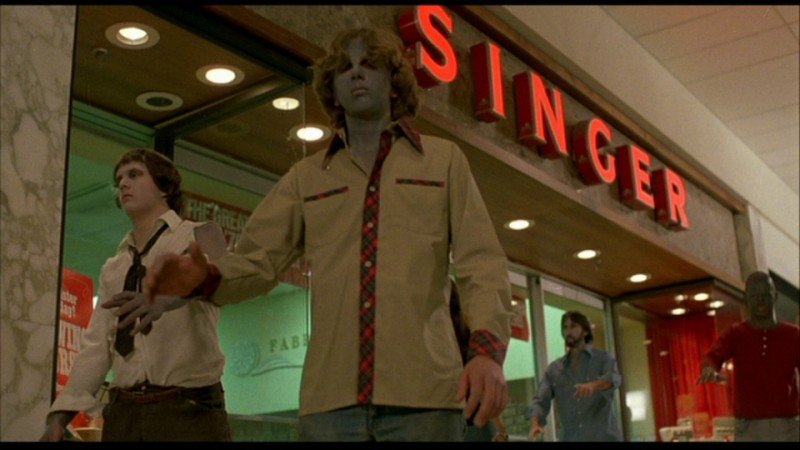
I'm sure you probably know the story by now. I mean, who doesn't? Even if you haven't seen it, chances are you can guess. A zombie epidemic has gotten out of hand, and now four people (a news reporter, her boyfriend and two S.W.A.T. troopers) seek refuge from zombies. It's a format pretty much every zombie movie has followed since. Here, they're in an abandoned mall. Or maybe it's not abandoned, if you count the horde of zombies outside.

That's them.
The four lock themselves inside the mall with only some glass to keep the zombies out, which leads us to the first real issue of the film: the zombies weren't very threatening. They spent most of the film feebly pounding on the glass rather than actually breaking in. And while it does get pretty intense when a hundred zombies are piling up on the only exit, they still aren't as threatening as, say, a fast zombie, or a strong zombie.

But as it is, this is still an effective film. It could almost be played as a dark comedy, with characters riding through the mall on dirt bikes, bashing slow zombie skulls left and right.

(Like I said, gory even today.)

And that's the other issue. The gore itself just isn't great. I get that it's an older film, but still... the blood is bright red, almost orange, and the flesh is too rubbery. For such a big part of the film, this aspect is particularly disappointing. Still, I give the filmmakers props for getting this brutal, because up until this film, The Texas Chain Saw Massacre was about as gruesome as you could get, and anyone who's seen that knows how un-graphic it actually is.

So overall, this was a very solid film, and unlike pretty much every other grindhouse horror film, this is well-written, well-shot, and well-acted. There's a lot to like here... from zombie hunting hillbillies to the big, empty mall scenes (almost like The Shining before there was The Shining).

Not to mention, this is a two hour zombie movie with a majority of slow survival scenes, and almost forty years later, it still keeps our interest. Most two hour action thriller movies can't do that.

Recommended if you're into zombie films, or horror in general. Actually, scratch that. If you're looking for a good story, this is it.


Tuesday, April 3, 2012

Carnival of Souls (1962) Review


I watch a lot of old b-movies, and I've found that a most of the time it's either a hit or a miss when it comes to old horror; sometimes the film is just plain bad, and other times a movie is decent, more or less. Carnival of Souls is neither. In short, it's a brilliant film. It's relatively obscure, which is a shame since it deserves a wider audience.

After surviving a car accident, Mary Henry (Candace Hilligoss) moves away to a different town where she gets a job as a church organist. As she begins to adjust to the new town, she becomes uneasy due to her occasional hallucinations. That eerie abandoned carnival outside town isn't helping, either.

The only problem I found with this film is that a few scenes ran a bit long. I also noticed some dialogue that wasn't significant to the story and should have been cut.

The evening I watched this, I was thoroughly entertained, as well as impressed that the filmmakers could pull this off on such a small budget. It may not be perfect, but it's far better and more intelligent than almost all modern horror films. It shows that a great script can get you a long way.

Thursday, March 8, 2012

Night of the Living Dead (1968) Review


George A. Romero's original masterpiece that set the standard for all zombie films since. An entertaining film, with many twists and a lot of gore for its time.

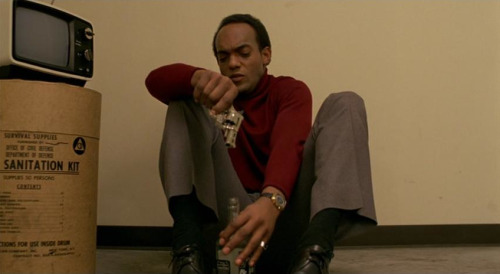
While visiting a rural cemetery, Barbara (Judith O'Dea) is attacked by a mysterious stranger. She hides in an abandoned farmhouse, where she meets Ben (Duane Jones), who boards up the house to keep out the bloodthirsty zombies that lurk outside.

The pacing of this film is slow, and sometimes that's not a bad thing, because it enables character growth. Sometimes the pacing is a problem, though, because it eventually becomes tiring to watch a man board up windows for minutes on end.

The acting is good in most parts, although there were a few brief moments when it wasn't so great. But this only happened a few times with minor characters, and the main actors were good enough to make up for it. The cinematography is excellent for a film considered by most to be a b-movie. This film has good directing, especially for a low-budget zombie movie.

Thanks to its well-written script, Night of the Living Dead has just enough twists to keep you guessing, but still retains a concise, easy-to-follow story. A must-see if you plan on writing a zombie film--or any other type of horror film, for that matter.

Thursday, March 1, 2012

The Day the Earth Stood Still (1951) Review

The Day the Earth Stood Still is a classic sci-fi film that has good special effects for its time but is unfortunately plagued with its mediocre writing and sometimes almost cringe-worthy acting.

The first few minutes of the film is made up of scene after scene of people reacting to a mysterious flying saucer that lands in Washington D.C. Klaatu (Michael Rennie) emerges from the space craft and informs the spectators that he has come on a goodwill mission.

Soon we learn that Klaatu’s mission is to deliver an “urgent” message to all of the world leaders. Upon hearing this, I was intrigued, wondering what the message could be.  Unfortunately, the third act of this film just doesn’t deliver.

After a few narrow escapes, some sneaking around, and a car chase, Klaatu finally reveals his message, which is a lot less breathtaking than I had once hoped.

Sure, some scenes were decent. Some were even good. Sadly, the bad parts outweigh the decent, making this film much less than what I had anticipated. Not a personal favorite, but I can see why it's considered such a classic.